


About
The Project
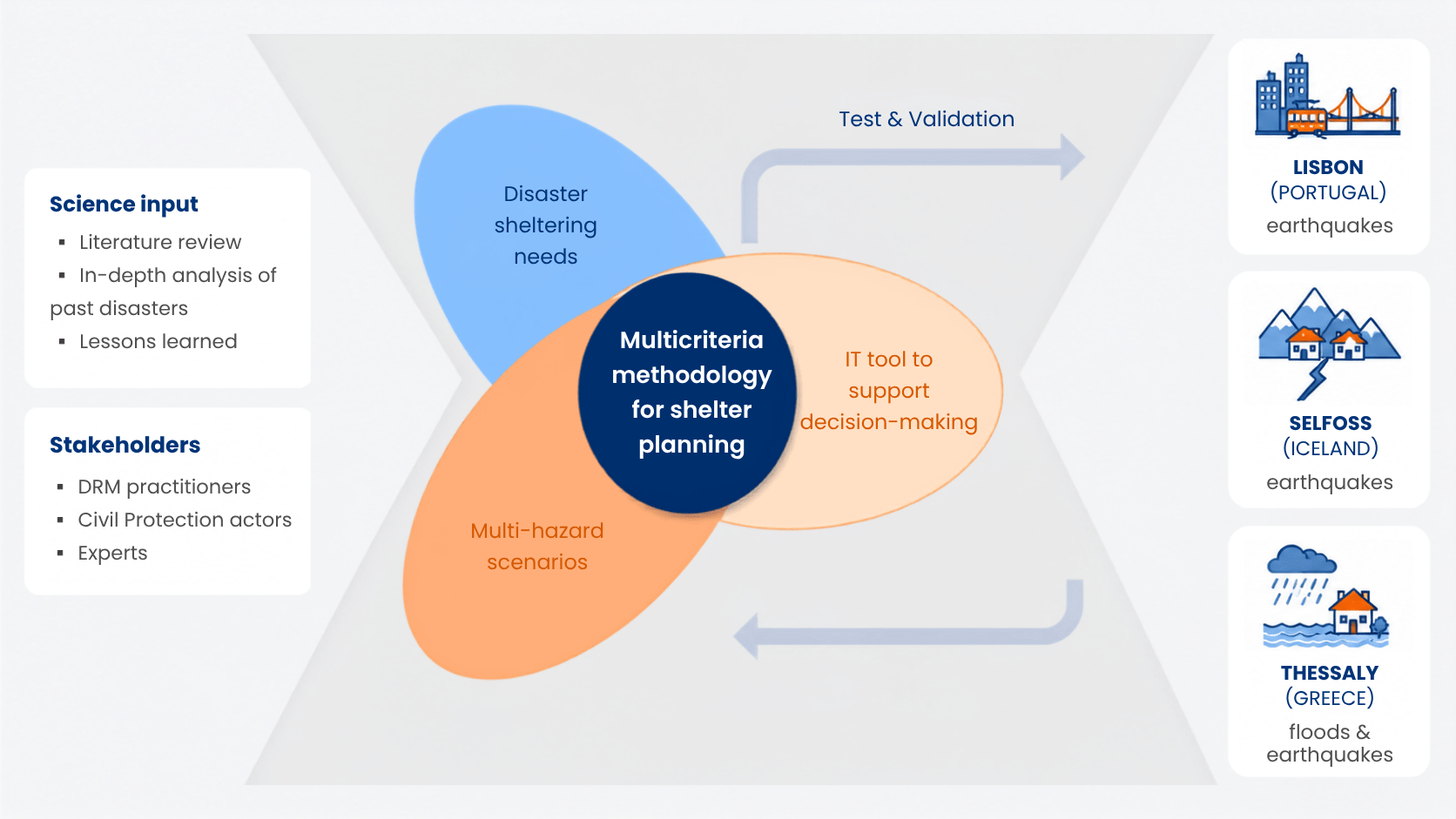
Prep2Shelter aims to foster anticipatory disaster shelter planning through the development of a multicriteria methodology and dedicated decision-support IT tool for civil protection authorities. These outputs will strengthen the capacity to anticipate shelter needs, assess available facilities, and support more effective disaster preparedness.
The project adopts a collaborative and interdisciplinary approach, fostering knowledge exchange among scientists, disaster risk management practitioners, and local communities. This enables the integration of a broad spectrum of knowledge, from science-based data to practical, field-based expertise.
Prep2Shelter’s key focus is collective infrastructure, such as multi-purpose public facilities and schools. These are commonly converted into emergency shelters during disasters. To ensure that these facilities can adequately meet the needs of affected populations, planning and preparedness are essential. Assessing their suitability across different hazard scenarios helps to create safer, more effective, and inclusive shelter solutions.
Objectives
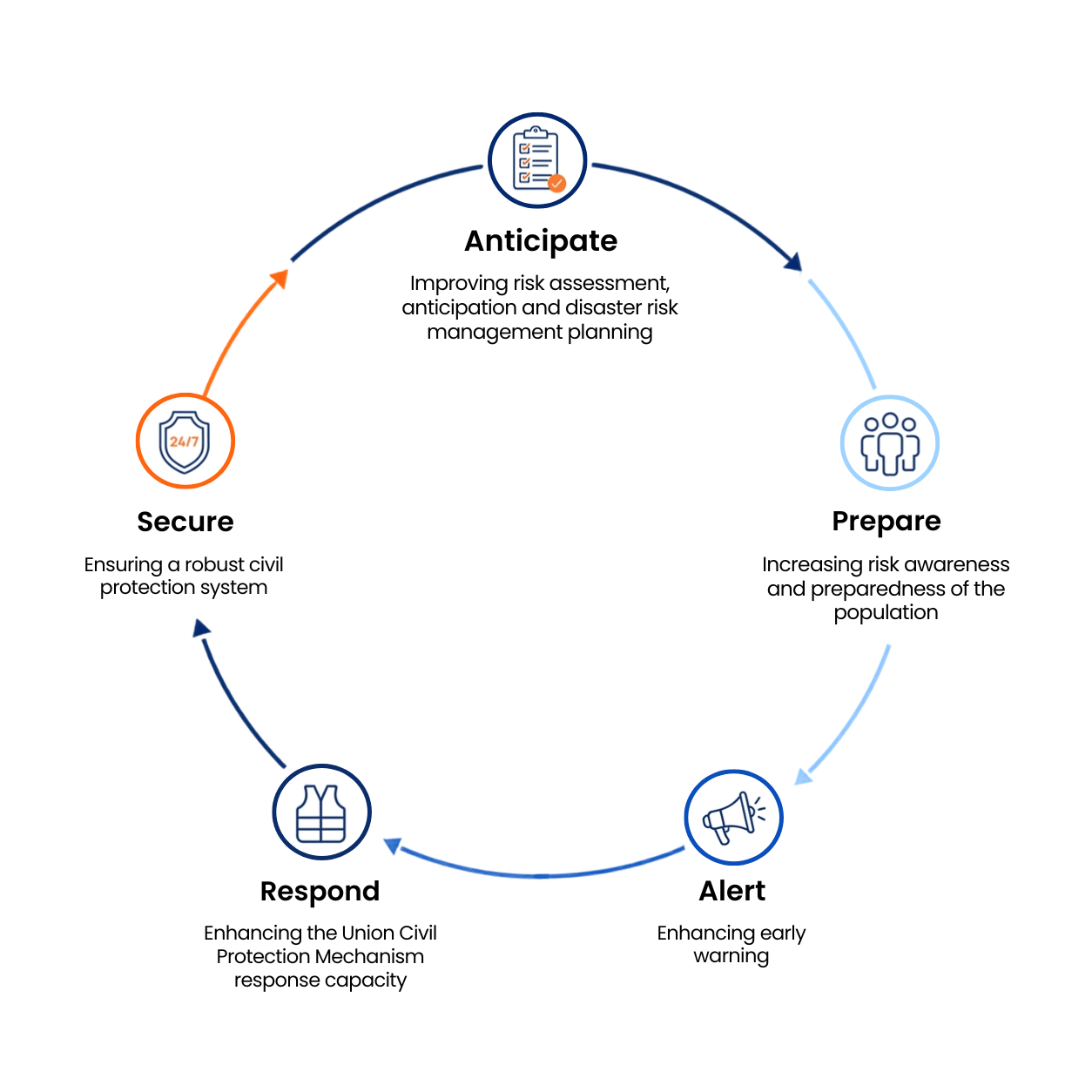
Prep2Shelter pursues four objectives aligned with UCPM Priorities 1, 2, and 4 (“Anticipate, Prepare, Secure”), with the ambition of improving the capacity to anticipate risks, strengthen preparedness, and deliver safe and reliable shelter solutions for affected populations.
-
1. Develop a multicriteria methodology and decision-support tool
Develop a multicriteria methodology to support shelter planning and selection, together with a flexible, user-friendly tool to facilitate decision-making.
-
3. Incorporate the needs of communities and vulnerable groups
Enhance the effectiveness of temporary shelter planning by integrating requirements related to safety, sanitation, cultural diversity, privacy, and the specific needs of vulnerable groups.
-
2. Enable collaboration and knowledge exchange
Bring together disaster risk management (DRM) stakeholders to share expertise, lessons learned, and tailor multicriteria methodology to real-world decision-making needs
-
4. Improve anticipatory shelter planning capacity
Foster anticipatory disaster shelter planning by supporting preparedness approaches and fostering collaboration and knowledge exchange among disaster risk management stakeholders
WorkPlan
The Prep2Shelter is organised into 8 Work Packages (WPs):
Management and Coordination
- Lead by LNEC
Scoping and learning from disasters
- Lead by INGV
Multicriteria Methodology
- Lead by LNEC
IT decision support tool
- Lead by LNEC
Engagement and Knowledge Sharing
- Lead by SPI
Pilot Study 1: Lisbon, Portgual
- Lead by LNEC
Pilot Study 2: Árborg, Iceland
- Lead by EERC
Pilot Study 3: Thessaly, Greece
- Lead by NTUA
Multicriteria methodology will be tested and validated in three pilot areas
These pilot areas will address a range of risks, including earthquakes and floods, ensuring that the solutions are adaptable to different contexts. Hands-on training and capacity-building activities will further support the uptake of results by civil protection authorities and disaster risk management (DRM) stakeholders.
Consortium
Laboratório Nacional de Engenharia Civil (LNEC)
PortugalLNEC — Portugal
LNEC is a public institute of Science and Technology (S&T), with the status of a State Laboratory that conducts research in all fields of civil engineering, providing a unique multidisciplinary perspective. Safety is a central focus of research at LNEC. It holds a leading position in the fields of seismic, flood, and wind hazards and risk assessment. It provides independent, evidence-based scientific input to support risk mitigation policies and actively assists civil protection authorities in the development of emergency plans at both national and regional levels.
Visit Website

Istituto Nazionale di Geofisica e Vulcanologia (INGV)
ItalyINGV — Italy
INGV is a public geoscience research institution that conducts research in the fields of earthquakes, volcanoes, and the environment, while promoting responsible research and innovation by making its results accessible and encouraging societal participation. It has extensive experience in studying the social dimensions of risk, including risk perception, community preparedness, education and risk communication to foster informed and resilient communities. With its nationwide presence and continuous monitoring of natural hazards, INGV also plays a crucial role in Italy’s emergency response by supporting civil protection authorities.
Visit Website

Ethnicon Metsovion Polytechnion (NTUA)
GreeceNTUA — Greece
NTUA, through its School of Civil Engineering, is a leading institution in the field of civil engineering. The school’s primary mission is to advance scientific knowledge and technological innovation while contributing to the country’s technical, economic, and social development. One of NTUA’s core research areas is structural engineering, with a focus on theoretical and experimental structural analysis, earthquake engineering, reinforced concrete, structural dynamics, and the design of steel structures. Additional research topics include post-earthquake recovery, damage prediction, soil–structure interaction, and the multi-hazard resilience of infrastructure.
Visit Website

Earthquake Engineering Research Centre (EERC)
IcelandEERC — Iceland
EERC is a research institution of the University of Iceland that conducts research in seismic hazard and wind engineering. The Centre operates and maintains the Icelandic Strong-Motion Network and distributes data through the Internet Site for European Strong-Motion Data (ISESD). On-going measurement programs include full-scale measurements of wind and earthquake-induced structural response, as well as a recording of data required for civil and environmental engineering design.
Visit Website

Sociedade Portuguesa de Inovação (SPI)
PortugalSPI — Portugal
SPI is a private consulting company established in 1996, acting as an active hub within national and international networks connected to the research and innovation sectors. It promotes collaboration between public and private organizations at both national and international levels, namely with national and regional civil protection authorities. SPI has led the design communication, dissemination, and exploitation strategies of numerous EU-funded projects.
Visit WebsiteThe National Laboratory for Civil Engineering (LNEC), in Portugal, carries out a wide range of activities related to the built and natural environment. Safety is a central focus of its research, with risk management becoming an increasingly important area of intervention. LNEC holds a leading position in the fields of seismic, flood, and wind hazards and risk assessment. LNEC provides independent, evidence-based scientific input that informs risk mitigation policies and has actively assisted civil protection authorities in the development of emergency plans at national and regional levels. Leveraging on the multidisciplinary expertise of its staff, LNEC will lead the activities of WP1, in which all partners participate. It will also lead WP3, WP4 and WP6 and contribute to WP2, WP5, WP7 and WP8.
www.lnec.pt
The National Institute of Geophysics and Volcanology (INGV), in Italy, is a geoscience public research body. Its contribution to Prep2Shelter draws on its extensive experience in studying the social dimensions of risk, including perception, preparedness, and community engagement, as well as designing and evaluating educational and communication strategies for fostering informed and resilient communities. With its nationwide presence and continuous monitoring of natural hazards, INGV plays a crucial role in Italy’s emergency response, supporting civil protection authorities, and is a key asset to the project. INGV will lead activities in WP2 and play a significant role in WP5.
www.ingv.it
The School of Civil Engineering of the National Technical University of Athens (NTUA) is a leading research institutions in Europe, ranked by the Shanghai Ranking system 5th Top Civil Engineering School in 2022. The school has expertise in Computational Fluid Dynamics (Prof. D. Istrati), Fluid-Structure Interaction, Structural Modelling, Optimization Algorithms, AI for health monitoring (Prof. Lagaros), and Earthquake Engineering, Post-Earthquake Recovery, Damage Prediction, Soil-Structure Interaction and Multi-hazard enhancement of infrastructure (Prof. Sextos). NTUA is leading WP8 and participating in WP2, WP3 and WP5.
www.ntua.gr
The Earthquake Engineering Research Centre (EERC) at the University of Iceland is a key research institution with expertise in seismic hazard and risk assessment, operation of the national seismic network, and detailed knowledge of building vulnerability. Within the Prep2Shelter project, EERC plays a central role by leading the Iceland pilot study (Work Package 7), where it develops earthquake shelter needs scenarios to test and validate the project’s methodology in a real-world context. It is responsible for modelling earthquake impacts, assessing building damage and shelter demand, and supporting the identification and prioritization of emergency shelter solutions in collaboration with national stakeholders such as municipalities, civil protection authorities, and the Red Cross.
eerc.hi.is
Sociedade Portuguesa de Inovação (SPI) is an international consulting firm founded in 1996, with experience in supporting innovation, knowledge transfer, and cooperation between the public and private sectors. SPI works closely with companies, universities, research centres, and public authorities to develop projects that promote economic and social development. In Prep2Shelter, SPI leads Work Package 5, which focuses on communication, dissemination, and outreach. This includes promoting collaboration and knowledge sharing among stakeholders, developing guidance and educational materials, and making sure that the project results are widely shared and continue to be used beyond the project’s duration.
www.spi.pt
The Disaster Resilience Goals
Trends in natural hazards and disasters indicate increasing impacts worldwide, particularly in terms of economic losses and exposure. In Europe, global warming is increasingly affecting regions, with climate-related hazards such as heatwaves, floods, storms, and wildfires becoming more severe and impactful.
These trends highlight the need for stronger cooperation among Member States, enhanced preparedness, and increased resilience across the European Union. In 2023, the European Commission established the Disaster Resilience Goals within the framework of the Union Civil Protection Mechanism, aimed at strengthening prevention, preparedness, and coordinated response capacities across Europe.
Prep2Shelter directly contributes to the implementation of the EU Disaster Resilience Goals (UDRG) by addressing key strategic priorities, including improved risk anticipation, enhanced preparedness, and strengthened disaster response capacities.